A Markdown editor hosted in the EU
markoto is a collaborative Markdown editor run by a Swiss company. On markoto.app, your documents, images and backups are stored in the EU (France), and the AI features use providers based in the EU. This page sets out where data goes and what we don't claim, so you can check it against your own requirements. The privacy policy is the binding text; where this page and the policy differ, the policy applies.
Who runs it
markoto.app is operated by LatentSpace Labs GmbH in Zurich, Switzerland. The privacy policy is written for both the Swiss Federal Act on Data Protection (FADP) and the EU GDPR. Switzerland and the EU recognise each other as providing adequate data protection, so data can move between them without extra safeguards.
Where your data is stored
- Documents, comments, history and account data: OVHcloud managed PostgreSQL in France.
- Images and the daily database backups: OVHcloud Object Storage in France. Backups are encrypted and kept for about 30 days.
- Knowledge files you upload to a workspace: converted to text on our own servers, then the original file is deleted. Only the text and its search index are kept.
Who else receives data
These are the service providers (sub-processors) markoto.app uses today, read from the same list as the sub-processor page:
- OVHcloud (Managed PostgreSQL)EU · no transfer
Primary application database, Y.js document state, knowledge embeddings
- OVHcloud (Object Storage)EU · no transfer
Image uploads, knowledge-base originals (deleted post-processing), database backups
- Mistral AI SASEU · no transfer
AI text generation for the writing assistant, including the free AI allowance: open-weight and Mistral models served and processed by Mistral (currently DeepSeek V4.1 Flash, GLM-5.3 Flash and Mistral Large 4; their developers receive no data); voice transcription (Voxtral). All requests go to Mistral's EU endpoint (data centres in the EU and EFTA)
- Jina AI GmbHEU · no transfer
Embedding generation for knowledge-base RAG; single-URL page content extraction for the fetch-URL tool (Jina Reader; the URL is sent for every user, including users with their own AI provider)
- Staan (European Search Perspective SAS)EU · no transfer
Web search for the AI writing assistant (the search query is sent for every user, including users with their own AI provider), via a proprietary European search index (EU-only routing)
- Black Forest Labs GmbHEU · no transfer
Image generation via FLUX (EU-pinned data plane)
- Google LLC (OAuth)United States · Data Privacy Framework, SCCs as fallback
Sign-in via Google account (no other Google data accessed)
- GitHub, Inc.United States · Data Privacy Framework, SCCs as fallback
Sign-in via GitHub account (no other GitHub data accessed)
- Functional Software, Inc. (Sentry)Global · Data Privacy Framework, SCCs as fallback
Application error + performance telemetry, stored in Sentry's EU (Frankfurt) data region
- Resend, Inc.Global · Data Privacy Framework, SCCs as fallback
Transactional email delivery, account-deletion confirmations, data-export-ready notifications, breach notifications
The live list for markoto.app, read from the same registry as the legal page. Sub-processors, with privacy policies and DPAs
In short: storage and every AI provider sit in the EU. The providers based in the United States are used for narrow jobs:
- Google and GitHub only if you choose to sign in with them. markoto reads your name, verified email address and account ID, and nothing else from those accounts.
- Resend delivers the few emails markoto sends (for example invitations and account-deletion confirmations).
- Google Ads receives the ad click identifier described under "No tracking cookies" below, only if ad conversion measurement is switched on.
- Sentry receives error reports. They are stored in Sentry's EU region (Frankfurt); the US company may access them for support and operations.
These transfers rely on the EU-U.S. and Swiss-U.S. Data Privacy Framework, with standard contractual clauses as fallback, as the privacy policy describes.
AI features
The writing assistant, voice input, web search, page fetching and image generation all go through markoto's own AI gateway to EU-based providers: Mistral AI (France; data centres in the EU and EFTA countries) for text and voice, Jina AI (Germany) for knowledge-base search and reading web pages, Staan (France) for web search and Black Forest Labs for images (EU-pinned region).
- Nothing is sent to an AI provider unless you use an AI feature. AI needs an account; anonymous visitors can't use it.
- No training on your content. markoto doesn't train models. Jina AI and Staan state that they don't train on request data; with Mistral AI and Black Forest Labs, markoto has opted out of training.
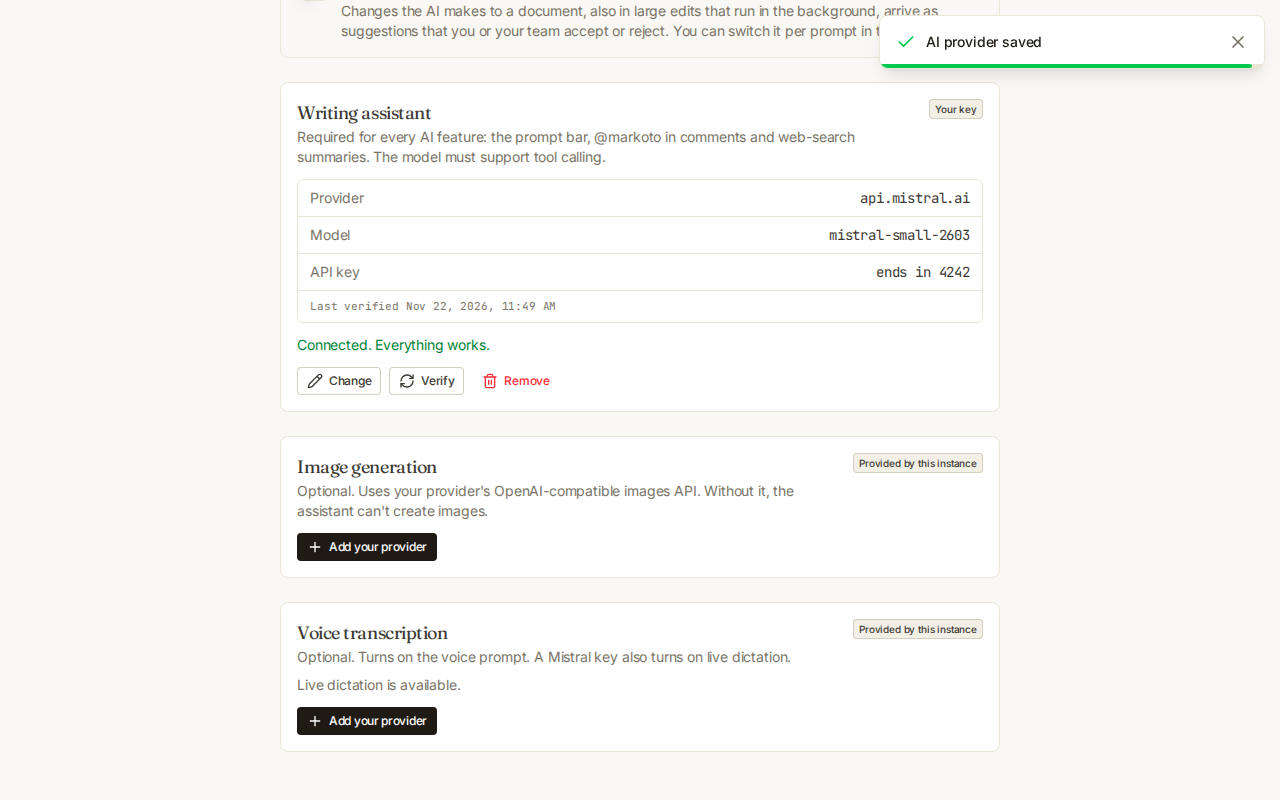
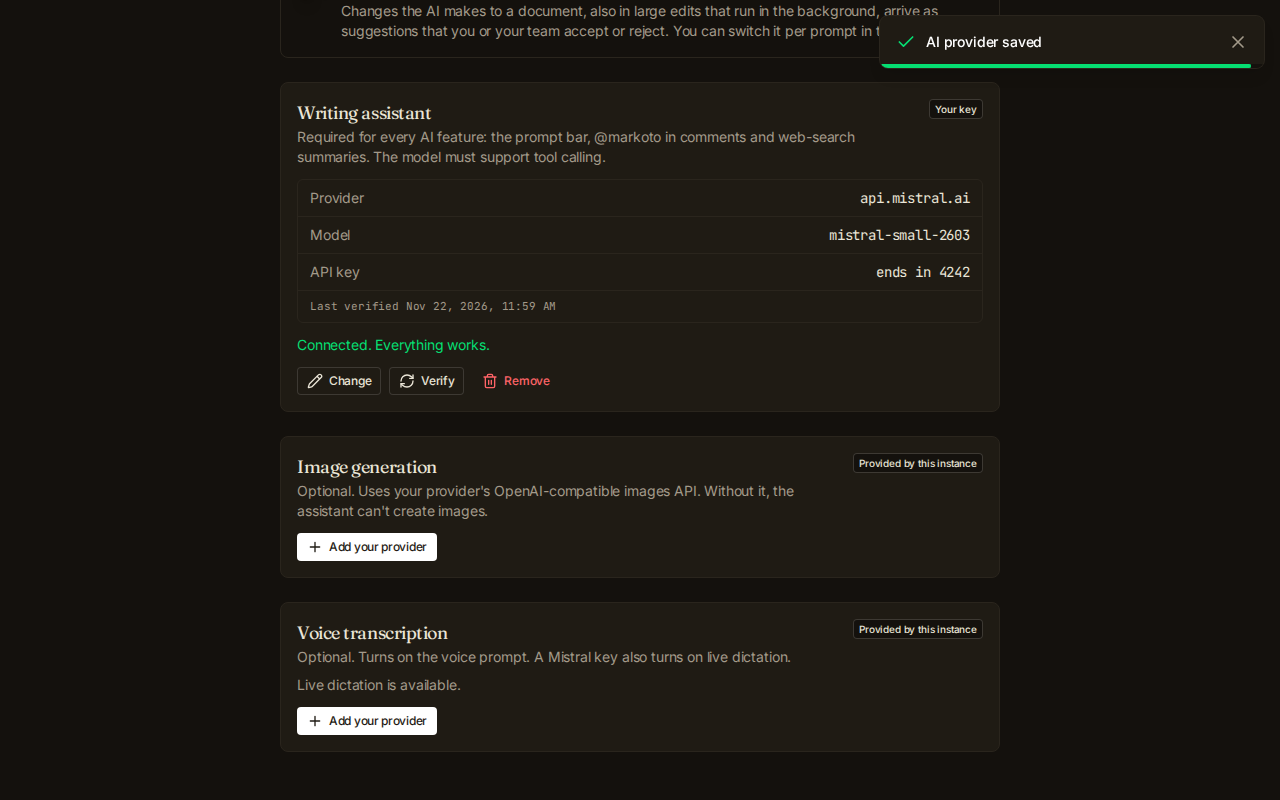
- Your own provider is your choice. If you connect your own AI provider under Settings › AI provider, your AI requests go to that provider under your own agreement with it. It is then not markoto's sub-processor, and where it processes data depends on the provider you pick.
- Prompts and tool calls are kept for 90 days for abuse review, then deleted.
No tracking cookies
markoto.app uses only storage that is strictly needed to run the service: the sign-in session, your language, and a few keys for anonymous documents. Visits to the public pages, like this one, are counted with a statistics tool we run ourselves, without cookies and without storing anything on your device; documents are never counted. There is no session replay, no advertising in the product and no cross-site tracking, so there is no cookie banner. If the operator has switched on ad conversion measurement for markoto's own Google ads, a visit that arrives from one of those ads and then signs up, joins the waitlist or creates a first document is recorded on our server with the ad's click identifier and passed to Google Ads (no name, email address or IP address) for 90 days at most; this rests on our legitimate interest rather than on consent, no Google script or cookie is loaded, nothing is stored on your device, and browsers that send Global Privacy Control or Do Not Track are left out. It is off unless the operator enables it. The privacy policy lists every cookie and storage key and explains the statistics and the ad measurement.
Documents are not indexed by search engines: every document page sends a noindex instruction. A link can still be passed on, so treat a shared link as public.
For schools, teams and companies
- Data processing agreement. When you create a workspace, markoto acts as your processor for the content your team puts in it, under the Data Processing Addendum. You accept it when you create your first workspace.
- Export. Every user can download a ZIP of everything markoto holds about them (documents as Markdown, comments, settings, logs) from their profile.
- Deletion. Deleting an account takes effect after a 30-day grace period you can cancel. Then documents, workspaces where you are the only member and AI records are deleted, and your comments on other people's documents are anonymised.
- New sub-processors are announced to workspace owners at least 30 days in advance.
What markoto does not claim
- No certification. There is no such thing as a "GDPR certificate" for a product, and markoto holds no security certification of its own (no ISO 27001, no SOC 2). The storage provider publishes its own certifications.
- Not end-to-end encrypted. markoto's servers can read your documents; they have to, to render pages, make PDFs and run the AI. Data is encrypted in transit and at rest. If the server must not be able to read your content, use an end-to-end encrypted tool instead.
- Not a legal opinion. Whether markoto meets your organisation's obligations is for you or your data protection officer to decide. The privacy policy, the DPA and the sub-processor list are there to make that check possible.
Full control: run it yourself
If your data must not leave your own infrastructure, self-host markoto. A self-hosted instance runs the same code as markoto.app with Docker Compose on your own server, with sign-in through your own identity provider (OpenID Connect) and AI only on providers you configure, including local models. The preview and PDF export load nothing from third parties, so an instance works on an isolated network. On your own instance, you are the operator and the controller; markoto.app's providers are not involved.
Questions
Where are my documents stored?
Is markoto GDPR compliant?
Do US companies get my documents?
Does markoto use my documents to train AI?
Is there a data processing agreement?
Is markoto end-to-end encrypted?
Can I host markoto myself?
Updated November 17, 2026